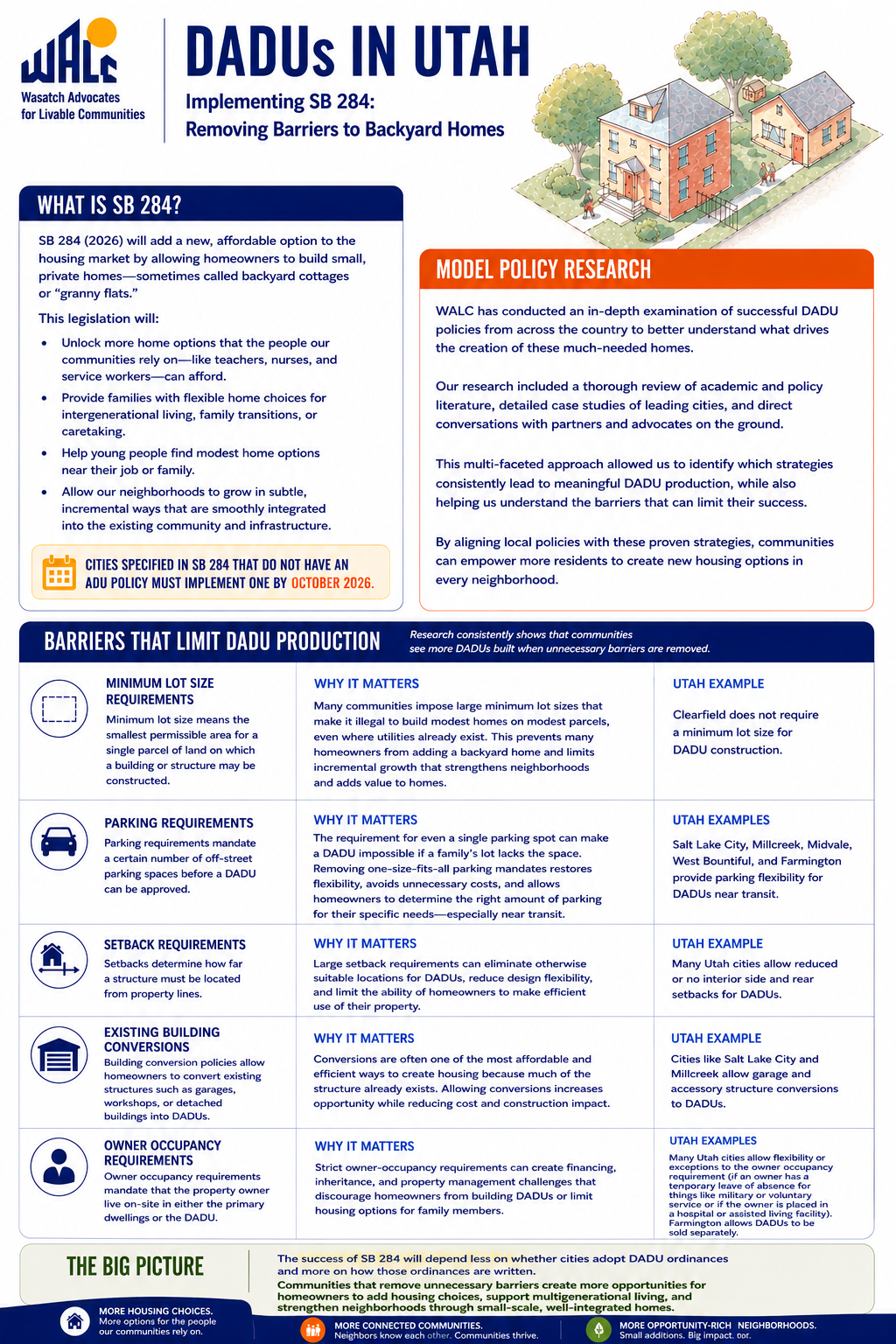
Even before the state legislature acted, several Utah cities had already started loosening restrictions on Detached Accessory Dwelling Units (DADUs) to give homeowners more flexibility and create housing options for smaller households, lower-income residents, and seniors hoping to age in place. But in some parts of the Wasatch Region, local ordinances remained restrictive or simply didn't address detached units at all — creating real barriers for homeowners and limiting how much new housing supply could be added within existing neighborhoods.
That changed this year with the passage of Senate Bill 284 (2026), Local Land Use Modifications, sponsored by Sen. Lincoln Fillmore with House sponsorship from Rep. Jill Koford. SB 284 is a sweeping land use and water policy bill, but one of its most consequential provisions for housing is its expansion of detached accessory dwelling units (DADUs) — think backyard cottages, guest houses, or garage apartments.
What SB 284 Requires
Housing affordability was the top issue Utahns wanted the state legislature to address this session. Utah is short at least 52,000 homes; fifty-eight percent of voters under 30 have said housing is so expensive they have considered moving out of state. Utah’s housing market is now the ninth most expensive in the nation, and an outdated patchwork of regulations is preventing us from easing this crisis. SB 284 is a step toward ending blanket bans on backyard cottages and cutting red tape that stands in the way of building these more attainable homes.
Under SB 284, cities with a population of 10,000 or more (communities subject to Moderate Income Housing Reporting, listed here) must allow detached ADUs on qualifying single-family lots, with implementation required by October 2026. Previously, cities had broad discretion to prohibit detached ADUs outright, and many did.
Key provisions of the bill include:
-
A statewide minimum lot size floor of 11,000 square feet for DADUs — though cities retain the choice to allow them on smaller lots if they prefer.
-
SB 284 prohibits requiring more than 2 parking spaces for a DADU ≥650 sq ft and 1 parking space for a DADU <650 sq ft.
-
Local control over additional details — cities still set their own setbacks, height limits, design standards, and owner-occupancy rules.
Utahns Already Agree
This reform reflects where Utah voters already are. A January 2026 poll from the Libertas Institute found that 82% of Utahns believe building a backyard cottage or converting a garage into a living space should be legal. The same polling found that 82% of Utahns want property owners — not city officials — to be the key decision-maker on what happens on their own property, with only 13% saying local government should decide independently.
Why Lot Sizes and Parking Rules Matter So Much
One of the biggest practical hurdles to building an ADU isn't whether it's legal. It's whether the lot can physically accommodate the unit and an additional off-street parking space. Many single-family lots simply can't fit both.
This isn't a hypothetical concern. A study in Kent, Washington found that requiring an extra off-street parking space made it impossible for 85% of single-family homeowners to build an ADU. When Seattle eliminated its mandatory parking requirement for ADUs, the number of ADU permits issued tripled. Cities that adopt DADU ordinances with strict added-parking mandates risk legalizing ADUs on paper while making them functionally unbuildable for most homeowners.
Minimum lot size requirements pose a similar problem. SB 284 sets a statewide floor of 11,000 square feet for DADUs, but a city's other dimensional standards — setbacks, lot coverage limits, height restrictions, and easement requirements — determine how much of that lot is actually buildable. A property that technically meets the minimum lot size threshold may still have a buildable envelope too small or too oddly shaped to accommodate a separate structure once required setbacks on all sides, existing structures, driveways, and utility easements are accounted for. Irregularly shaped lots, corner lots with double frontage setbacks, and properties with steep grades or easements running through the buildable area are especially likely to be excluded in practice, even where they're permitted on paper.
Cities that pair the 11,000 square foot floor with excessive setbacks or low lot-coverage maximums risk creating an ordinance that looks compliant on paper but leaves only a small fraction of eligible lots with enough usable space to build a DADU.
Where Things Stand Across the Region
WALC has been tracking how cities across the Wasatch Region are responding to SB 284's October 2026 deadline. Of the jurisdictions subject to the law within our region, our review finds that the following cities will need to draft a DADU ordinance for the first time or substantially amend an existing one: Syracuse, Woods Cross, Draper, Sandy, South Jordan, Park City, Provo, and Roy.
Herriman has already moved. The city adopted its DADU ordinance on May 27, 2026, shortly after SB 284's passage — making it one of the first cities in the region to comply with the new law. Herriman's ordinance is a mixed bag from a housing-supply standpoint:
-
The good: Herriman set its minimum lot size at 10,000 square feet, slightly below the statewide 11,000 sq ft floor — a small but meaningful expansion of eligible lots compared to what the state minimum would have required.
-
The less good: Herriman opted not to allow internal ADUs and detached ADUs on the same lot (meaning homeowners must choose one or the other, not both), and the city adopted the state's recommended off-street parking standards rather than relaxing them — which, as the Kent and Seattle examples above illustrate, could meaningfully limit how many lots can actually accommodate a DADU in practice.
Based on WALC's analysis, roughly 50,000 residents live in the cities still in the process of updating their DADU ordinances — meaning the decisions these cities make over the coming months will shape housing options for a substantial share of the region.
Why This Matters for Real People
The benefits of ADUs aren't abstract. They give intergenerational families practical, dignified ways to live near one another without overcrowding. ADUs let grandparents downsize while staying close to their kids and grandkids — hence the term “granny flat.” They let young adults live affordably in a parent's backyard while saving for their own home. And they give teachers, firefighters, nurses, and other essential workers an affordable way to live in or near the communities they serve, often while helping the homeowner cover their mortgage.
ADUs also support more sustainable land use. Adding housing within existing neighborhoods makes more efficient use of infrastructure, water, and services that are already in place, rather than pushing growth further into farmland and open space along the edges of the Wasatch Front. Much of Utah's recent housing growth has occurred in lower-density suburban and exurban communities along and beyond the Wasatch Front. A 2024 legislative audit found that without changes allowing more housing units on less land, parts of the Wasatch Front could begin to run out of housing capacity within two decades, and that the state would need to add roughly 27,900 housing units per year to keep pace with projected growth. This pattern of low-density, outward-expanding development requires major new investments in roads, water, and sewer infrastructure, increases land and water consumption, and adds to traffic congestion — costs that fall on existing residents and local governments alike.
In contrast, allowing more housing types — including ADUs, missing-middle housing, and small-lot development — within existing neighborhoods makes more efficient use of infrastructure, services, and jobs that are already in place, while giving homeowners and communities a tool to add supply without large new public investments.
What Cities Should Do Next
Each city retains the ability to craft a DADU ordinance that reflects its own community's priorities — SB 284 sets a floor, not a template. But cities that want their ordinances to actually result in new housing, rather than technical compliance with no real-world effect, should avoid the kinds of restrictions (oversized lot minimums, added parking mandates, and bans on pairing internal and detached units) that have historically made ADUs legal in name only.